Beginner Machine Learning Projects
These eight beginner machine learning projects run on a normal laptop with Python, pandas, and scikit-learn. No GPU needed, and each one trains in seconds.
1. Iris Flower Classification
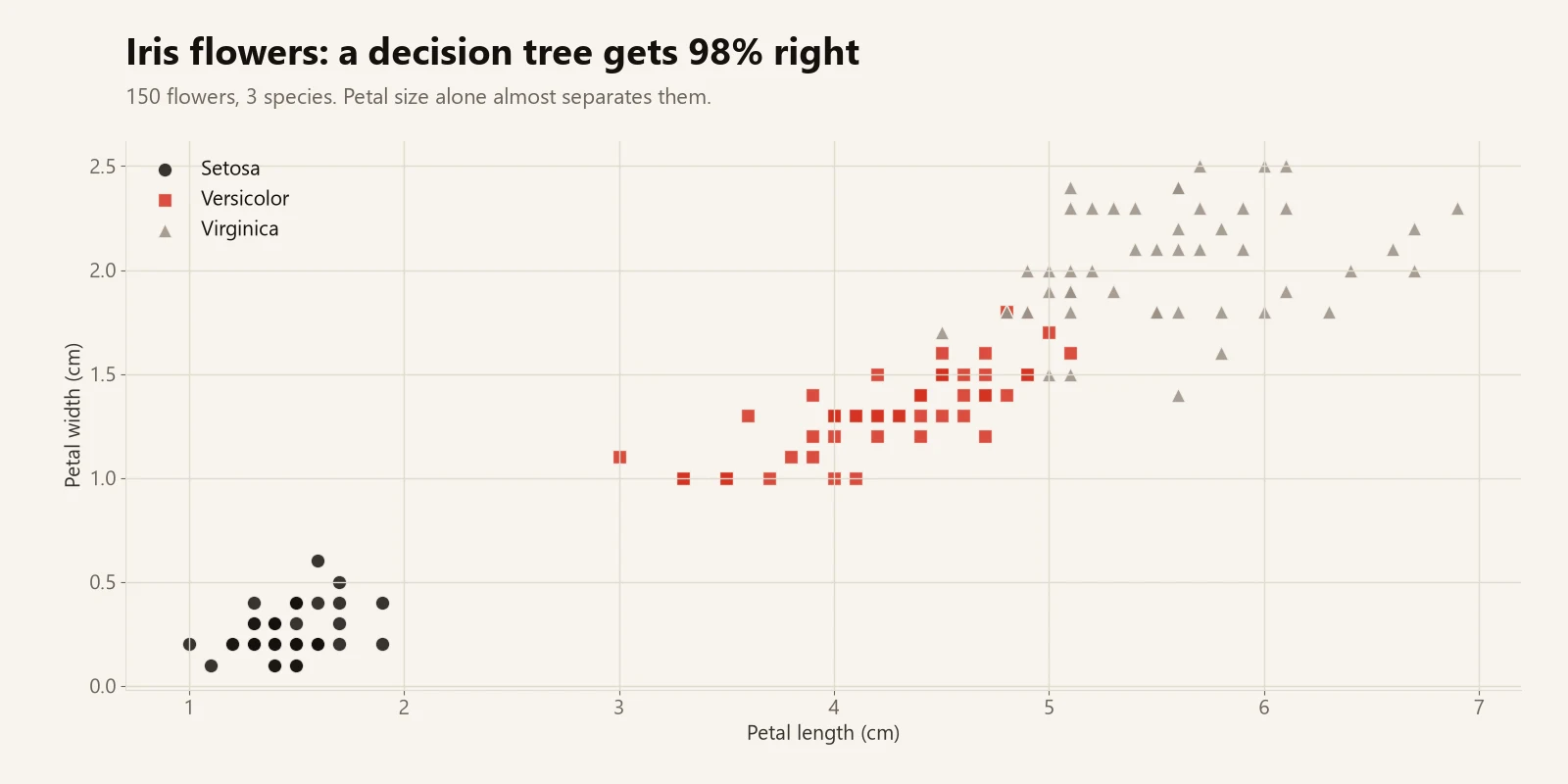
Iris flower classification is the "hello world" of machine learning projects. You get four measurements for each of 150 flowers (sepal and petal length and width) and teach a model to name the species: setosa, versicolor, or virginica.
It's a perfect first project because the data is tiny and clean, so you can focus on the workflow: load the data, split it into training and test sets, train a model, and check its accuracy. A small decision tree got 98% of the test flowers right in my run, and the chart shows why: petal size alone almost separates the three species.
Jason Brownlee's guide to your first machine learning project in Python walks through it step by step.
You'll need: Python, pandas, scikit-learn, and matplotlib.
Dataset: Iris from the UCI Machine Learning Repository. It also comes built into scikit-learn.
Source code: plot_iris_dtc.py in scikit-learn's examples on GitHub.
Take it further: wrap the model in a small Streamlit app where you type in four measurements and get the species back. It's your first deployed model.
2. Titanic Survival Prediction
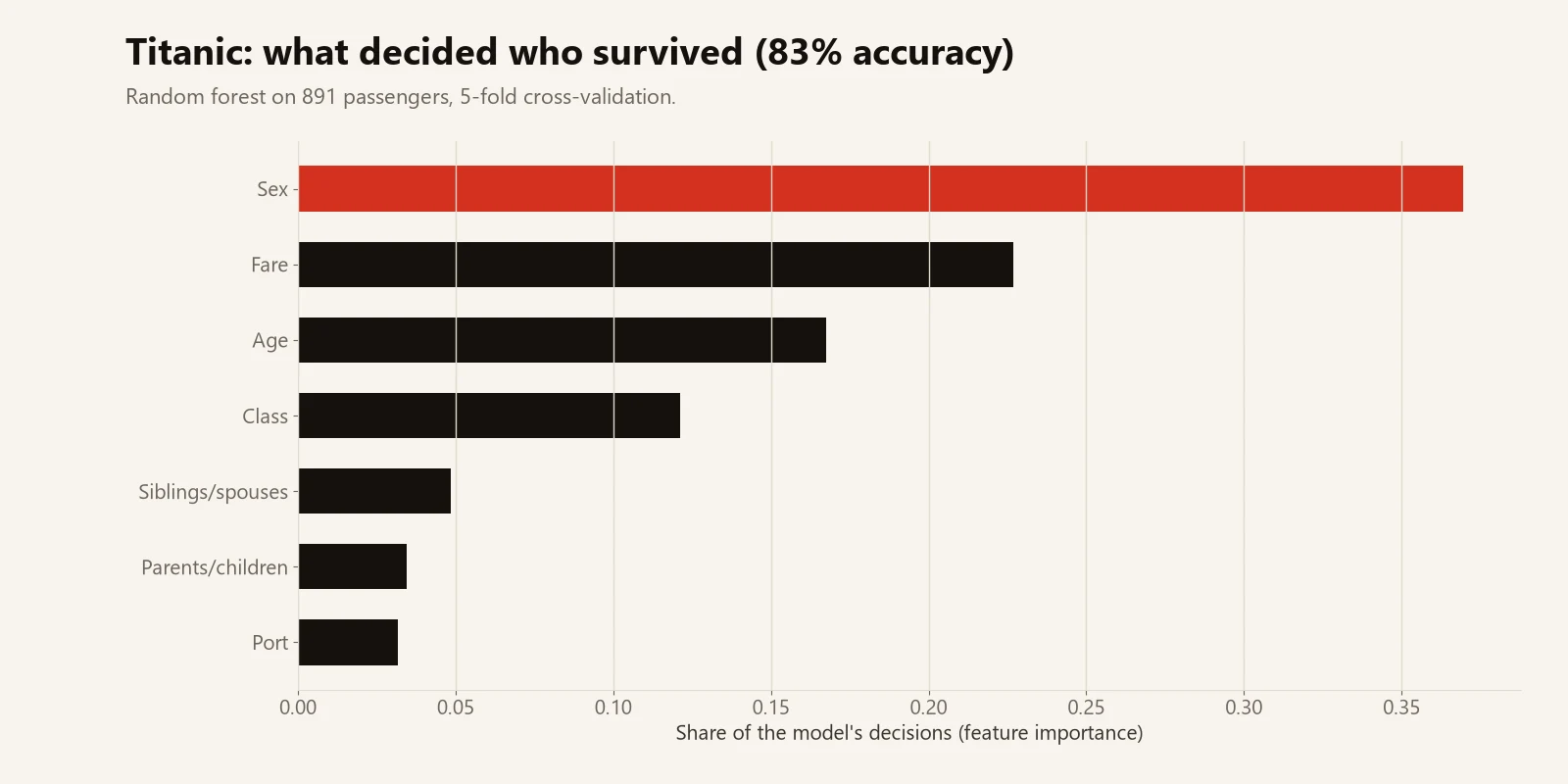
Titanic survival prediction is the project most people do first on Kaggle. You get details for 891 passengers (class, sex, age, fare, family aboard, and where they boarded) and predict who survived.
Only 38% of the passengers in the training data survived, but 74% of the women did, against 19% of the men. A random forest picked that up straight away: sex drives most of its decisions, followed by fare, age, and class. It scored 83% accuracy with 5-fold cross-validation, a solid score for this dataset.
This is where you learn the unglamorous parts of machine learning: filling in missing ages, turning text columns into numbers, and not fooling yourself with your accuracy score.
You'll need: Python, pandas, and scikit-learn.
Dataset: Titanic, Kaggle's free practice competition.
Source code: the Titanic exercise in handson-ml3, chapter 3, Aurélien Géron's notebooks for Hands-On Machine Learning.
Take it further: pull each passenger's title (Mr, Mrs, Master, Miss) out of their name and add family size as a feature, then submit to Kaggle and watch your leaderboard score move.
3. House Price Prediction
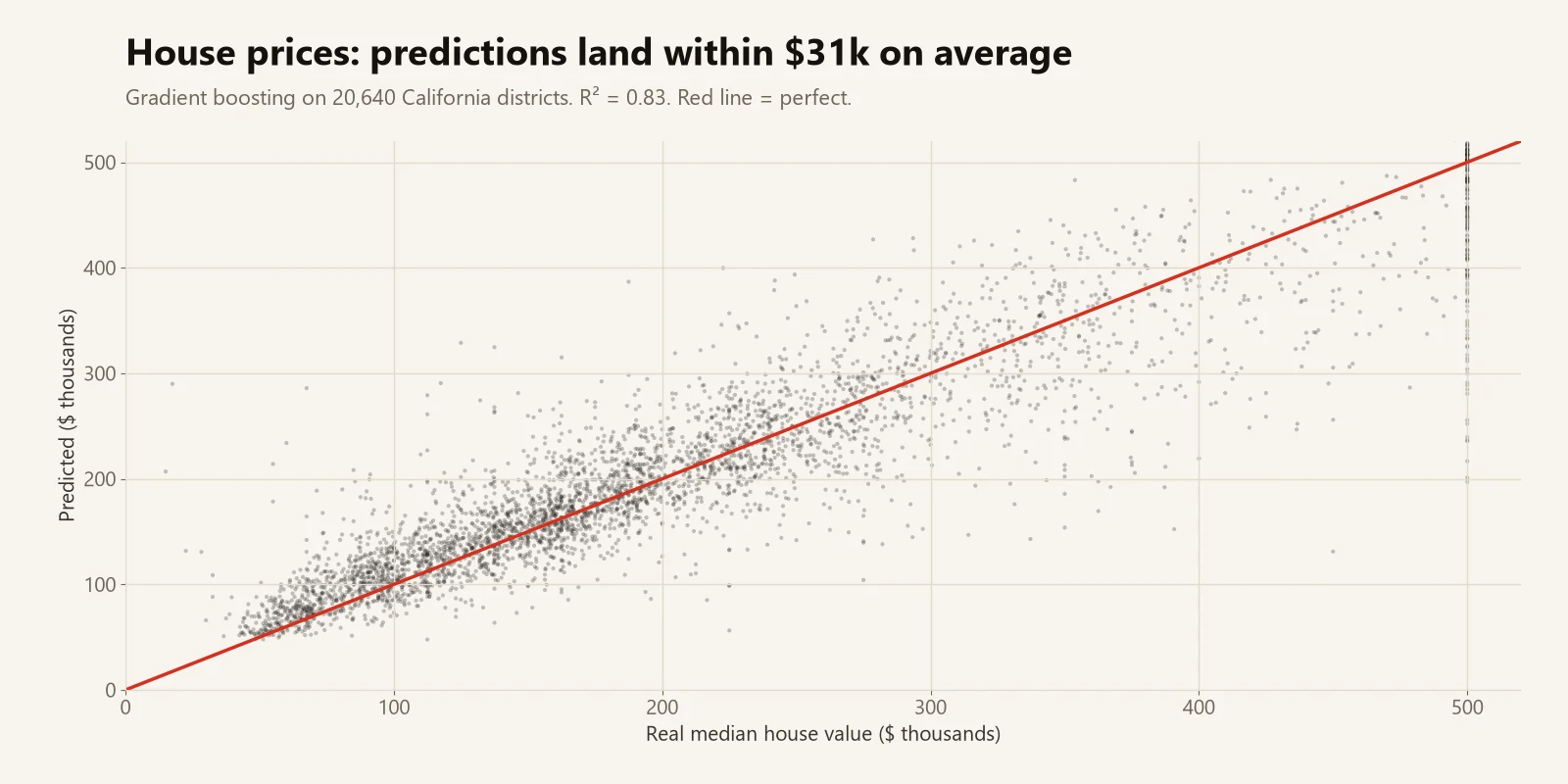
House price prediction is the classic regression project: instead of picking a category, the model predicts a number. You feed it things like income, location, and house age, and it estimates the price.
Chapter 2 of Hands-On Machine Learning uses the California housing data (20,640 districts from the 1990 census) for a complete end-to-end machine learning project. A gradient boosting model got within $31,000 of the real median value on average in my run, with an R² of 0.83. The vertical line of dots on the right of the chart is a real quirk of the data: values were capped at $500,000, which is exactly the kind of thing you learn to spot.
You'll need: Python, pandas, scikit-learn, and matplotlib.
Dataset: California housing (built into scikit-learn), then Kaggle's House Prices competition with 79 features for homes in Ames, Iowa.
Source code: handson-ml3, chapter 2 on GitHub.
Take it further: scrape current listings in your own city (see project 17) and test whether your model still holds up on today's prices.
4. Spam Detection
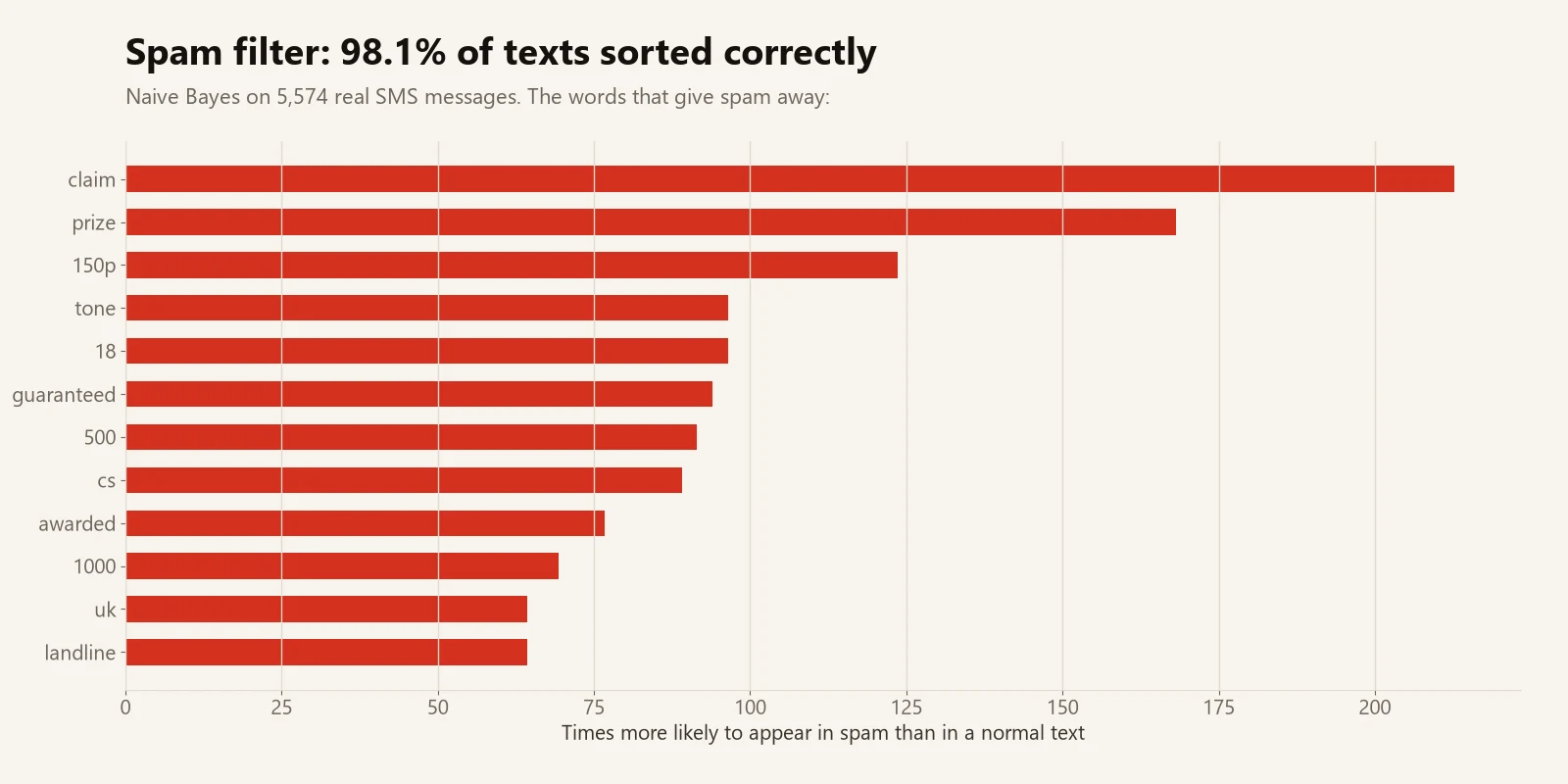
Spam detection is the best first text project. You turn each message into word counts and train a classifier to sort spam from normal messages.
The SMS Spam Collection has 5,574 real text messages, and 13% of them are spam. A plain Naive Bayes model sorted 98.1% of the test messages correctly in my run. The chart shows the words that give spam away: "claim" turns up more than 200 times as often in spam as in normal texts, followed by "prize" and "150p".
The real lesson is the cost of mistakes. A spam text that slips through is annoying, but a real message from your bank landing in spam is worse, so you'll learn to tune for precision, not just accuracy.
You'll need: Python, pandas, and scikit-learn.
Dataset: SMS Spam Collection from the UCI Machine Learning Repository.
Source code: the spam classifier exercise in handson-ml3, chapter 3, which uses Apache SpamAssassin's emails.
Take it further: swap the word counts for a small pre-trained language model from Hugging Face and see if it catches spam that Naive Bayes misses.
5. Handwritten Digit Recognition
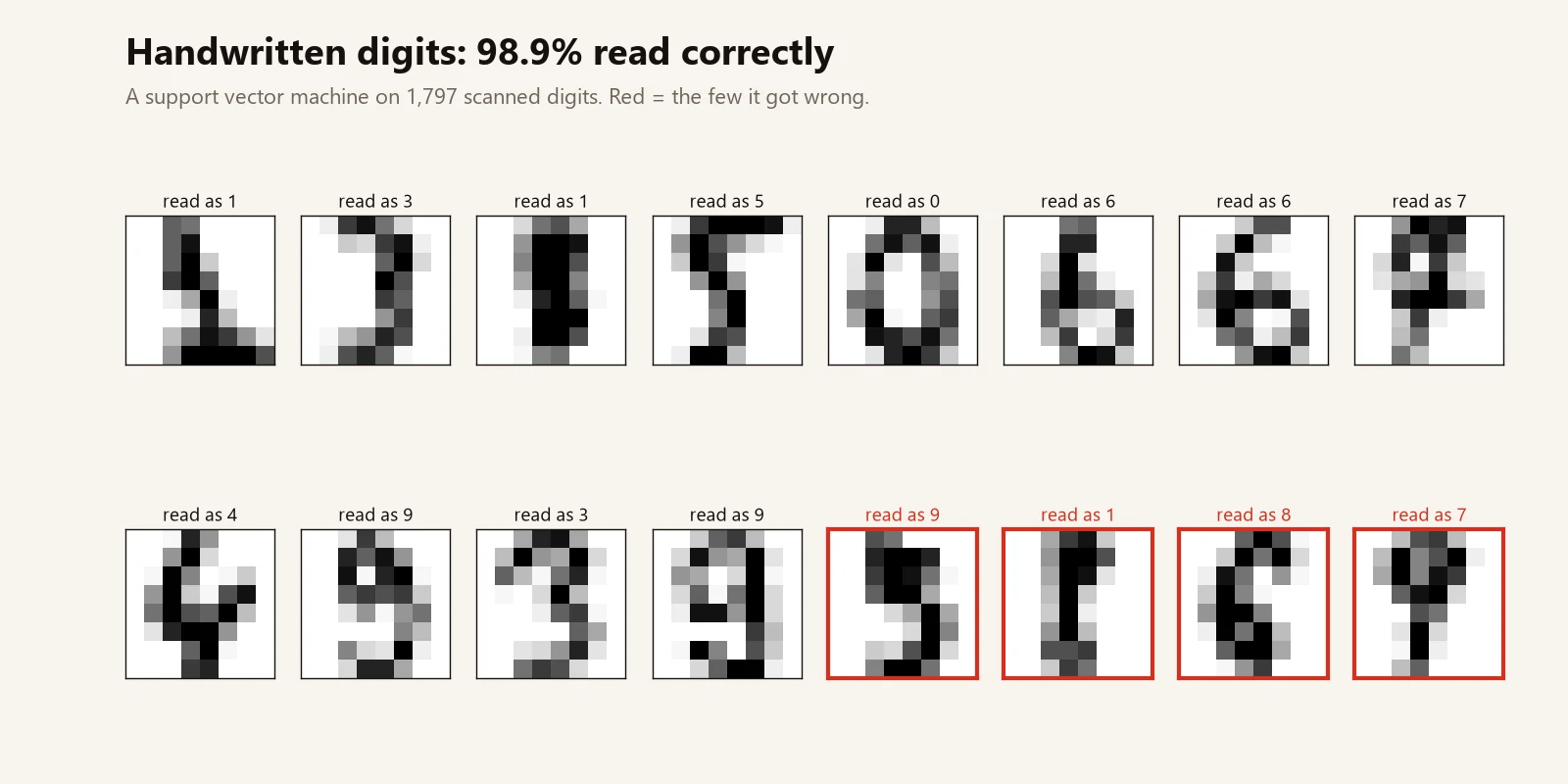
Handwritten digit recognition is the classic first deep learning project. MNIST has 70,000 small images of handwritten digits, and you train a neural network to read them.
You don't need deep learning to get started, though. A support vector machine read 98.9% of the test digits correctly on scikit-learn's smaller built-in digits set (1,797 tiny 8-by-8 scans). The red boxes in the chart are four of the handful it got wrong, and most are digits a person might squint at too.
PyTorch's official MNIST example trains a small convolutional neural network that runs fine on a laptop CPU.
You'll need: Python and PyTorch (or scikit-learn for the small version).
Dataset: MNIST, which PyTorch downloads for you.
Source code: the MNIST example in PyTorch's examples repo on GitHub.
Take it further: build a web page where you draw a digit with your mouse and the model reads it live. It's the same idea as the handwriting recognition project in my list of computer vision projects.
6. Wine Quality Prediction
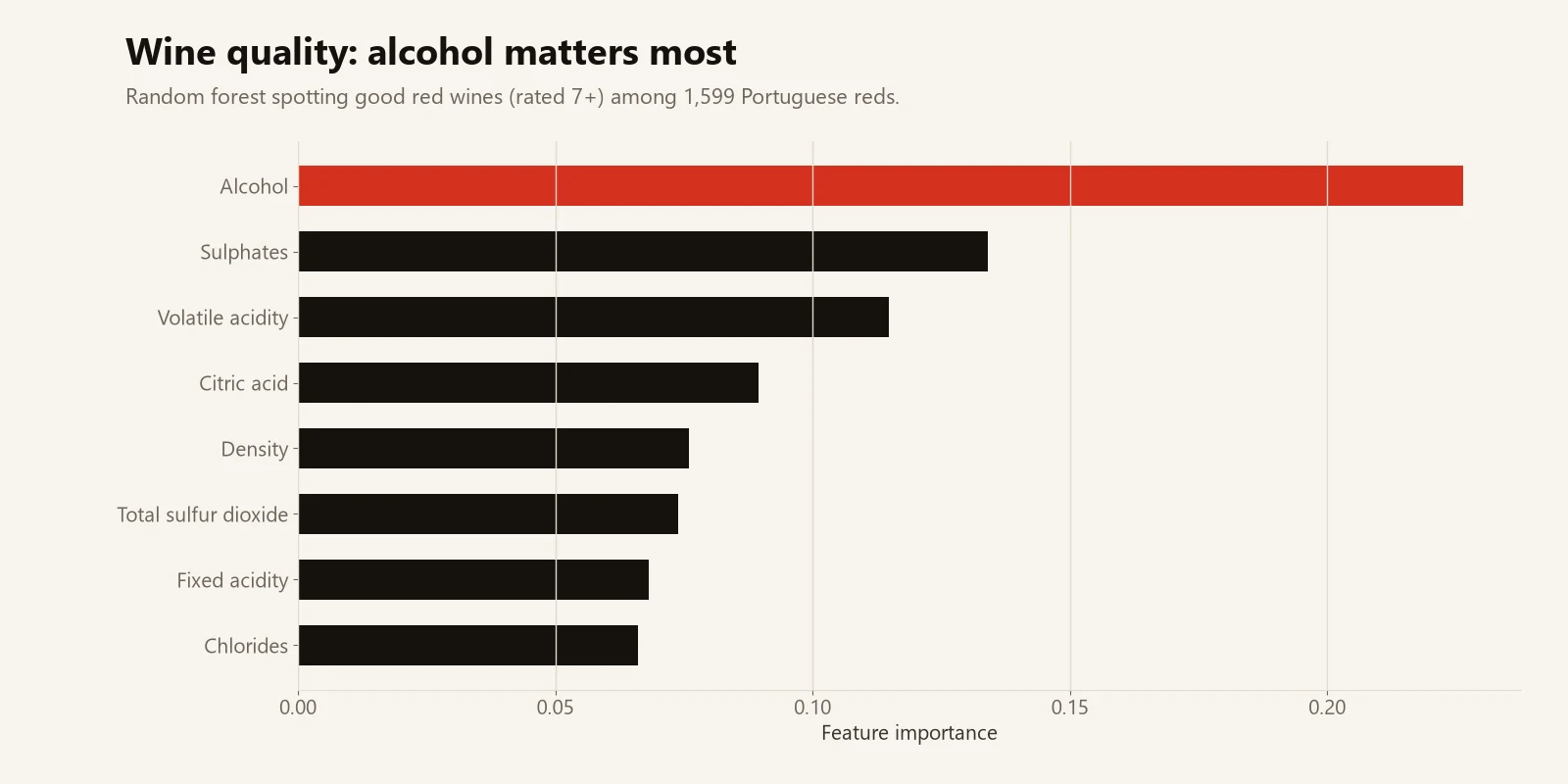
Wine quality prediction uses lab measurements (acidity, sugar, sulphates, alcohol, and so on) to predict how wine tasters scored 1,599 Portuguese red wines. Alcohol is the strongest signal by a long way.
This project hides a trap that catches a lot of beginners. Only 13.6% of the reds are rated 7 or higher, so a model that calls every wine "not good" is right 86% of the time. My random forest scored 85% accuracy, which sounds fine until you compare it to that lazy baseline. Use precision, recall, and the F1 score instead, and balance the classes.
You'll need: Python, pandas, and scikit-learn.
Dataset: Wine Quality from the UCI Machine Learning Repository, with 1,599 reds and 4,898 whites.
Source code: Wine-Quality-Prediction on GitHub, which builds a full pipeline from data checks to training.
Take it further: predict the exact score as a regression problem, then check whether a model trained on reds works on whites.
7. Heart Disease Prediction
Heart disease prediction is the classic healthcare machine learning project. You use patient details like age, cholesterol, blood pressure, and chest pain type to predict whether someone has heart disease.
The Cleveland data most tutorials use has just 303 patients, so it trains in a blink. What makes it interesting is the choice of metric: missing a sick patient is far worse than a false alarm, so recall matters more than accuracy. It's also a good place to learn logistic regression, because doctors can read its coefficients.
You'll need: Python, pandas, and scikit-learn.
Dataset: Heart Disease from the UCI Machine Learning Repository.
Source code: Heart-Disease-Prediction-using-Machine-Learning on GitHub, which compares several classifiers.
Take it further: explain each prediction with SHAP, so you can show which measurements pushed a patient's risk up or down.
8. Customer Segmentation
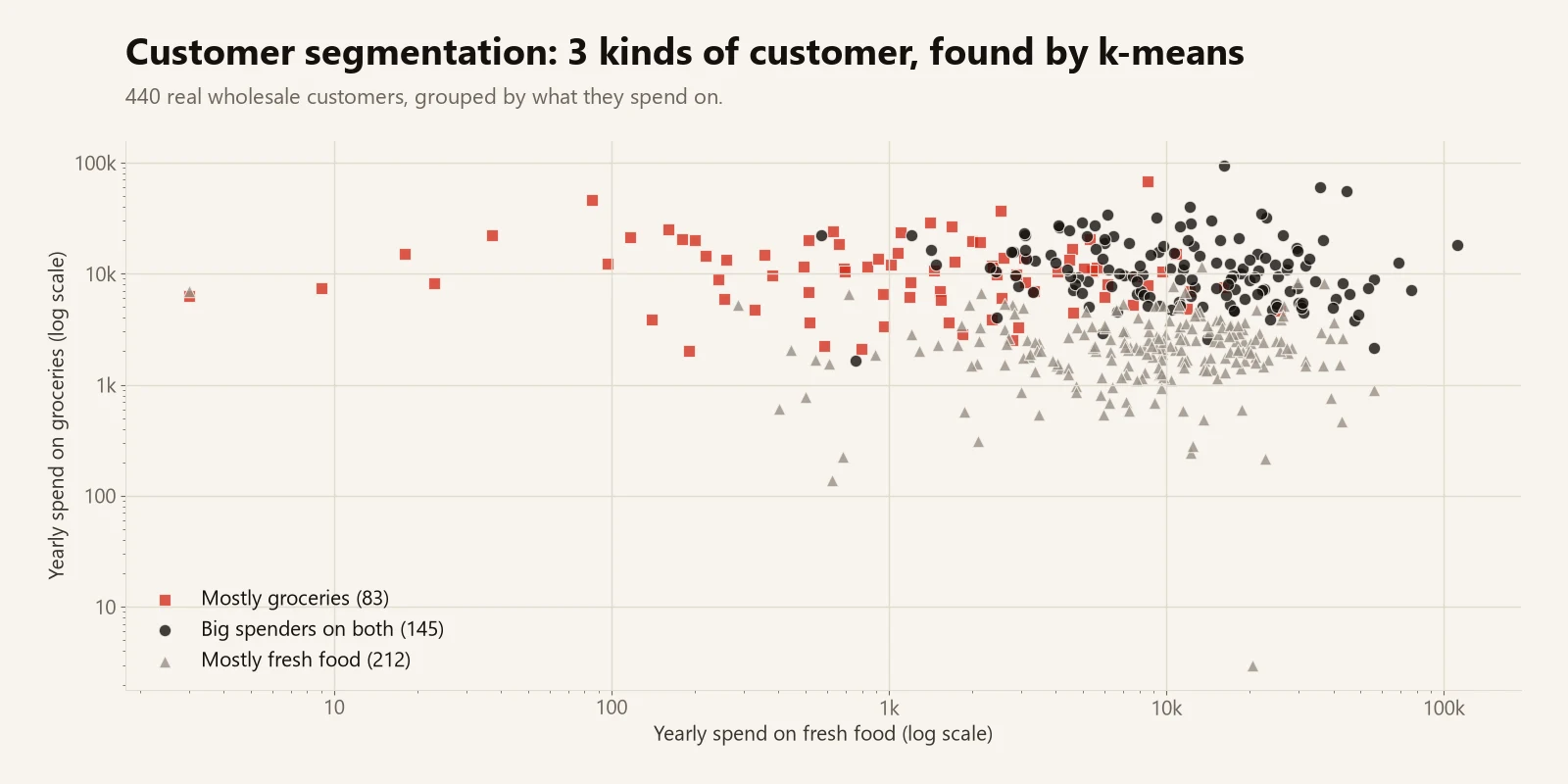
Customer segmentation is the classic unsupervised machine learning project. There are no right answers to learn from. Instead, a clustering algorithm like k-means groups customers by how they behave, and you work out what each group means.
I ran k-means on 440 real wholesale customers and their yearly spend on six product types. It found three groups: customers who buy mostly fresh food (212), big spenders on everything (145), and customers who buy mostly groceries (83). Here's the cool part: 209 of the 212 fresh-food buyers turned out to be hotels, restaurants, and cafés, even though the model never saw that label.
You'll need: Python, pandas, scikit-learn, and matplotlib.
Dataset: Wholesale customers from the UCI Machine Learning Repository, or the Mall Customers dataset on Kaggle.
Source code: Marketing-Data-Science on GitHub, which has a k-means segmentation notebook alongside other marketing case studies.
Take it further: segment shoppers from a real online store with RFM (recency, frequency, and monetary value) using Online Retail II.
These twelve intermediate machine learning projects use bigger, messier data: imbalanced classes, text, audio, time series, and data you collect yourself. Most still run on a laptop.
9. Loan Approval Prediction
Loan approval prediction is a good first finance project. You predict whether a loan application gets approved from details like income, loan amount, credit history, and employment.
The dataset is small and full of gaps, so most of the work is cleaning. It also raises a question every finance machine learning project has to answer: the data includes gender and marital status, and you'll need to decide whether a model should use them at all. Test whether your model treats similar applicants differently, and write down what you find.
You'll need: Python, pandas, and scikit-learn.
Dataset: Loan Prediction on Kaggle.
Source code: Loan-Approval-Prediction on GitHub.
Take it further: add SHAP explanations, so each declined application comes with the reasons behind it, the way a real lender has to explain a decline.
10. Credit Card Fraud Detection
Credit card fraud detection is the go-to project for learning about imbalanced data. The Kaggle dataset has 284,807 card transactions from European cardholders, and only 492 of them are fraud. That's 0.17%.
A model that never flags anything scores 99.8% accuracy, so accuracy is useless here. You'll learn precision-recall curves, class weights, resampling, and how to pick a decision threshold based on what a missed fraud costs compared with a blocked real purchase.
You'll need: Python, pandas, scikit-learn, and XGBoost or LightGBM.
Dataset: Credit Card Fraud Detection on Kaggle.
Source code: the Fraud Detection Handbook on GitHub, a free book with code from the machine learning group at the Université Libre de Bruxelles, the same team behind the dataset.
Take it further: turn it into a real-time system that scores each transaction as it arrives (see project 20).
11. Customer Churn Prediction
Customer churn prediction tells a business which customers are about to leave. It's one of the most useful ecommerce and subscription machine learning projects, because a model that spots unhappy customers early is worth real money.
The Telco Customer Churn dataset covers 7,043 customers with their plans, contracts, charges, and whether they left. Gradient boosting models like XGBoost and LightGBM do well here, and you'll learn to explain the results to a manager, not just a data scientist.
You'll need: Python, pandas, scikit-learn, and XGBoost or LightGBM.
Dataset: Telco Customer Churn on Kaggle.
Source code: Telecom-Customer-Churn-prediction on GitHub.
Take it further: rank customers by churn risk times what they spend, so the retention team calls the ones that matter most first.
12. Movie Recommendation System
A movie recommendation system predicts what someone will want to watch next, like Netflix does. It's the classic way to learn collaborative filtering: people who liked the same films as you probably like similar new ones.
The MovieLens datasets from GroupLens come in sizes from 100,000 to 32 million ratings, so you can start small and scale up. The Recommenders repo, started at Microsoft, has notebooks for everything from simple matrix factorization to deep learning recommenders, plus the ranking metrics to compare them.
You'll need: Python, pandas, and PyTorch or the Recommenders library.
Dataset: MovieLens from GroupLens.
Source code: Recommenders on GitHub.
Take it further: build product recommendations for a real store with Kaggle's H&M Personalized Fashion Recommendations competition data.
13. Sentiment Analysis of Reviews
Sentiment analysis reads a review and decides if it's positive or negative. It's one of the most practical marketing machine learning projects, because every business has reviews and nobody has time to read them all.
Start with a simple baseline (word counts and logistic regression), then fine-tune a small pre-trained model like DistilBERT with Hugging Face Transformers and compare the two on 50,000 IMDB movie reviews. It's a great hands-on intro to natural language processing.
You'll need: Python, Hugging Face Transformers, and a free Google Colab GPU.
Dataset: IMDB reviews on Hugging Face.
Source code: Hugging Face's text classification notebook on GitHub, plus the text classification guide.
Take it further: run it on a real store's product reviews and pull out what people complain about most, not just whether they're happy.
14. Fake News Detection
Fake news detection classifies news articles as real or fake from their text. It's a popular final year project, and it teaches you a lesson most tutorials skip: models cheat whenever they can.
In the popular Kaggle dataset, most real articles come from Reuters and many start with "(Reuters)". A model can learn that one word and look brilliant without understanding anything. Strip giveaways like that out, then test your model on articles from other sources to see how it really performs.
You'll need: Python, pandas, and scikit-learn (or Hugging Face for a transformer model).
Dataset: Fake and Real News on Kaggle.
Source code: Fake_News_Detection on GitHub, which uses the LIAR dataset of fact-checked statements.
Take it further: test your model on this week's news and see how well it holds up on stories it has never seen.
15. Sales Forecasting
Sales forecasting predicts how much a store will sell next week or next month. It's the most common ecommerce machine learning project in real jobs, and it teaches you time series, where the usual random train-test split is a mistake.
Kaggle's Store Sales competition has daily sales for 33 product families across 54 Favorita grocery stores in Ecuador, with holidays and oil prices thrown in. Start with a seasonal baseline, then try Prophet and gradient boosting through the Darts library.
You'll need: Python, pandas, and Darts or Prophet.
Dataset: Store Sales: Time Series Forecasting on Kaggle.
Source code: Darts on GitHub, whose example notebooks cover everything from simple baselines to deep learning models. Prophet is the simpler starting point.
Take it further: compare your model with Chronos, a pre-trained forecasting model that predicts without any training on your data.
16. Stock Price Prediction
Stock price prediction is one of the most searched machine learning projects, so here's the honest version: daily prices are close to random, and "tomorrow's price equals today's" is a baseline most models struggle to beat. Treat it as a time series exercise, not a trading system.
That still makes it a good project. Pull years of daily prices with yfinance, build features from past prices and volume, train an LSTM, and compare it with that naive baseline. The comparison is the part that impresses people.
You'll need: Python, pandas, yfinance, and PyTorch or TensorFlow.
Dataset: daily prices from yfinance.
Source code: Stock-Price-Prediction-LSTM on GitHub.
Take it further: predict volatility (how much a stock will move) instead of direction. It's far more predictable, and it's what risk teams actually forecast.
17. Web Scraping Price Predictor
A web scraping price predictor is one of the best machine learning projects for a portfolio, because you build your own dataset instead of downloading someone else's. You write a scraper, collect listings, clean them, and train a model on data nobody else has.
Practice on Books to Scrape, a fake bookstore built for scraping practice, with 1,000 books, prices, star ratings, and categories. Then move to a real site whose terms allow scraping, like a used car or rental listings site, and predict prices from the listing details.
You'll need: Python, Scrapy or Beautiful Soup, pandas, and scikit-learn.
Dataset: the one you scrape. Start with Books to Scrape.
Source code: quotesbot, Scrapy's example spider, and the Scrapy tutorial.
Take it further: run the scraper every day and train a model that predicts when a listing's price will drop.
18. Music Genre Classification
Music genre classification turns audio into features and predicts the genre. You'll learn how sound becomes numbers: spectrograms and MFCCs (a compact summary of a sound's tone) that a classifier or a small CNN can read.
The GTZAN dataset has 1,000 thirty-second clips across 10 genres, from blues to rock. Rock and country get mixed up a lot, which makes for a good write-up about where the model fails and why.
You'll need: Python, librosa, and scikit-learn or PyTorch.
Dataset: GTZAN on Kaggle.
Source code: MusicGenreClassification on GitHub.
Take it further: classify your own playlists, then read up on how AI music works to see where the same audio features show up in music generators.
19. Speech Emotion Recognition
Speech emotion recognition predicts how someone feels (calm, happy, sad, angry, fearful, and more) from the sound of their voice, not their words. It's used in call centers to flag upset customers.
The RAVDESS dataset has 24 professional actors saying the same sentences in different emotions, which makes it clean enough to learn on. You'll pull audio features with librosa and compare classic classifiers with a small neural network.
You'll need: Python, librosa, and scikit-learn.
Dataset: RAVDESS on Kaggle.
Source code: emotion-recognition-using-speech on GitHub.
Take it further: make it run live on your microphone, then test it on voices that aren't actors. Real emotion is much subtler.
20. Real-Time Machine Learning on a Data Stream
Most machine learning projects train once on a fixed dataset. Real-time machine learning projects learn from each new event as it arrives, which is how fraud checks, live pricing, and recommendation feeds work in production.
River is a Python library built for this. Its models update one example at a time, and it ships streaming datasets like credit card transactions, so you can watch accuracy change as the model learns. Compare it with a model trained once in batch, and see which one copes better when the data changes.
You'll need: Python and River.
Dataset: River's CreditCard stream and other built-in datasets.
Source code: River on GitHub, with tutorials in the River docs.
Take it further: put the model behind a small API and stream fake transactions at it to see how fast it scores each one.
Advanced Machine Learning Projects
These ten advanced machine learning projects need deep learning, bigger data, or production tools. Most need a GPU, and Google Colab or Kaggle's free GPUs will get you started.
21. Pneumonia Detection From Chest X-Rays
Pneumonia detection is a strong healthcare machine learning project for a final year. You train a convolutional neural network on 5,863 chest X-rays to tell normal lungs from pneumonia.
The Keras example uses transfer learning on a pre-trained model, which is how most real medical imaging projects start. You'll deal with class imbalance, image augmentation, and the ethics of the metric: missing pneumonia is worse than a false alarm. It's a learning project, not a diagnostic tool, and it sits right next to the medical image analysis project in my list of computer vision projects.
You'll need: Python, TensorFlow and Keras (or PyTorch), and a GPU.
Dataset: Chest X-Ray Images (Pneumonia) on Kaggle.
Source code: Pneumonia classification on TPU in the Keras examples, with a walkthrough on keras.io.
Take it further: add a heatmap (Grad-CAM) that shows which part of the X-ray the model looked at. Doctors won't trust a model that can't show its working.
22. Predictive Maintenance With Anomaly Detection
Predictive maintenance spots machines that are about to fail from their sensor readings, before they break. It's one of the most valuable real-world machine learning projects in manufacturing, and it usually starts with anomaly detection.
The Numenta Anomaly Benchmark has real sensor streams with labeled anomalies, including the temperature of an industrial machine before a failure. PyOD gives you dozens of anomaly detection algorithms with the same simple interface, so you can compare them quickly.
You'll need: Python, pandas, PyOD, and scikit-learn.
Dataset: the Numenta Anomaly Benchmark on GitHub, starting with machine temperature failure.
Source code: PyOD on GitHub.
Take it further: predict how long a jet engine has left before it fails using NASA's turbofan engine data from its prognostics data repository.
23. Marketing Mix Model
A marketing mix model works out how much each marketing channel (search ads, social, TV, email) actually adds to sales, and where the next dollar should go. It's one of the most in-demand machine learning projects for marketing analytics, now that tracking individual users keeps getting harder.
Meridian is Google's open-source marketing mix modeling framework. It's Bayesian, so you'll learn about priors, adstock (how long an ad keeps working after it runs), and saturation (when more spend stops paying off).
You'll need: Python and Meridian, plus a GPU for bigger models.
Dataset: your own weekly ad spend and sales, or the sample data in Meridian's docs.
Source code: Meridian on GitHub.
Take it further: compare Meridian's answer with PyMC-Marketing's marketing mix model on the same data.
24. Customer Lifetime Value Prediction
Customer lifetime value prediction estimates how much each customer will spend with a business in the future. It's a core ecommerce machine learning project, because it tells a store which customers are worth spending money to keep.
PyMC-Marketing includes the classic "buy till you die" models (BG/NBD and Gamma-Gamma) that predict how often each customer will buy again and how much they'll spend. Online Retail II has two years of real transactions from a UK online gift shop to train them on.
You'll need: Python, pandas, and PyMC-Marketing.
Dataset: Online Retail II from the UCI Machine Learning Repository.
Source code: PyMC-Marketing on GitHub.
Take it further: combine it with your churn model (project 11) and your segments (project 8) into one customer dashboard.
25. RAG Chatbot Over Your Own Documents
A RAG chatbot answers questions from your own documents, like a company handbook, course notes, or product manuals. RAG (retrieval-augmented generation) finds the most relevant chunks of text and hands them to a large language model, so its answers come from your documents instead of thin air.
RAG is behind most of the AI chatbots companies are building, which makes it one of the strongest machine learning projects for an AI engineering job. You'll learn embeddings, vector search, chunking, and the hard part: measuring whether the answers are actually right. Run the model on your own computer with my guide to running an LLM locally, or compare the cheapest LLM APIs if you'd rather pay per question.
You'll need: Python, LangChain or LlamaIndex, a vector database, and an LLM.
Dataset: your own documents.
Source code: rag-from-scratch on GitHub, LangChain's notebook series that builds RAG up one piece at a time.
Take it further: build a test set of 50 real questions with known answers, and track how often the chatbot gets them right as you change the chunk size and retriever.
26. Fine-Tune a Small LLM
Fine-tuning teaches an open-source language model a new skill or style with your own examples. With LoRA, you only train a small set of extra weights, so a small model can be fine-tuned on a single GPU.
Unsloth makes fine-tuning faster and lighter on memory, and its free notebooks run on Google Colab. Pick a narrow task, like turning support emails into tidy summaries or writing product descriptions in one brand's voice, because narrow tasks are where a small fine-tuned model can beat a big general one.
You'll need: Python, Unsloth or Hugging Face TRL, and a GPU (a free Colab one works for small models).
Dataset: your own examples, or one from Hugging Face Datasets.
Source code: the Unsloth notebooks on GitHub.
Take it further: compare your fine-tuned model with the base model and a big paid model on the same 50 test prompts, and write up the cost of each.
An AI agent is an LLM that can take actions: search the web, run code, call an API, then decide what to do next. Agents are the newest kind of machine learning project, and one of the fastest-moving.
smolagents from Hugging Face is a small, readable agent library, so you can see exactly what the agent is doing at each step. Build an agent that answers questions about a dataset by writing and running its own pandas code, then work out how to stop it doing silly things.
You'll need: Python, smolagents, and access to an LLM.
Dataset: your own tasks, or the exercises in Hugging Face's free AI agents course.
Source code: smolagents on GitHub.
Take it further: log every step your agent takes and measure how often it finishes the task, how many steps it needs, and what it costs per run.
28. Reinforcement Learning Game Agent
Reinforcement learning trains an agent by trial and error: it acts, gets a reward, and slowly learns what works. Games are the classic playground because the rewards are clear and the agent can practice millions of times.
Gymnasium gives you the games, from balancing a pole (CartPole) to landing a spacecraft (LunarLander) and Atari classics. Stable-Baselines3 gives you tested versions of algorithms like PPO and DQN, so you can focus on rewards and training instead of debugging math.
You'll need: Python, Gymnasium, Stable-Baselines3, and a GPU for Atari games.
Dataset: none. The agent creates its own data by playing Gymnasium environments.
Source code: Stable-Baselines3 on GitHub.
Take it further: design your own game environment, like a simple trading or delivery-route simulator, and teach an agent to win it.
29. End-to-End MLOps Pipeline
An MLOps pipeline takes a model from a notebook to production: tracked experiments, automated training, a deployed API, and monitoring that warns you when the model starts drifting. It's what separates people who can train models from people who can ship them.
DataTalks.Club's free MLOps Zoomcamp walks through the whole thing with real tools like MLflow and Docker. Take any model from this list (the churn model from project 11 works well) and give it the full production treatment.
You'll need: Python, MLflow, Docker, and a workflow tool like Prefect or Airflow.
Dataset: any dataset from this list of machine learning projects.
Source code: the MLOps Zoomcamp on GitHub.
Take it further: add automatic retraining when monitoring spots data drift, and write up what triggered it.
30. Fine-Tune an Image Generator With DreamBooth
DreamBooth teaches an image generation model a new subject, like your dog, your face, or a product, from just 3 to 5 photos. Afterwards you can put that subject into any scene with a text prompt.
The Diffusers library from Hugging Face has a ready-made DreamBooth training script, and with LoRA it fits on a single consumer GPU. You'll learn how diffusion models work, why they overfit so easily on a few images, and how to tell when training has gone too far.
You'll need: Python, Diffusers, PyTorch, and a GPU.
Dataset: 3 to 5 photos of your own subject.
Source code: the DreamBooth example in Diffusers on GitHub.
Take it further: compare your fine-tuned model with a style reference in an image generator like Midjourney, and see which keeps your subject looking right.
Machine Learning Projects by Industry
Many of the best machine learning projects come from one industry's real problems. Here's where the projects in this list fit, plus a few more ideas for each.
Machine Learning Projects in Finance
The best machine learning projects in finance are fraud detection, credit risk, and forecasting. In this list, that's loan approval prediction (project 9), credit card fraud detection (project 10), stock price prediction (project 16), and real-time scoring with River (project 20).
More fintech machine learning project ideas:
- Medical insurance cost prediction: predict yearly insurance charges from age, BMI, and smoking with the Medical Cost Personal dataset.
- Transaction categorization: sort bank transactions into categories like groceries, rent, and travel from their descriptions.
- Explainable credit scoring: add SHAP to any credit model so every decision comes with its reasons.
Machine Learning Projects in Healthcare
The best machine learning projects in healthcare use public, anonymized data, because real patient records come with strict privacy rules. In this list, that's heart disease prediction (project 7) and pneumonia detection from chest X-rays (project 21).
More healthcare machine learning project ideas:
Machine Learning Projects for Ecommerce and Marketing
The best ecommerce and marketing machine learning projects predict what customers will do next. In this list, that's customer segmentation (project 8), churn prediction (project 11), recommendations (project 12), review sentiment (project 13), sales forecasting (project 15), price scraping (project 17), the marketing mix model (project 23), and customer lifetime value (project 24).
More ecommerce machine learning project ideas:
- Fashion recommendations: predict what H&M shoppers will buy next in the H&M Personalized Fashion Recommendations competition.
- RFM segmentation: group shoppers by recency, frequency, and spend with Online Retail II.
- Price elasticity: estimate how sales change when prices change, from a store's own sales history.
What Are the Best Machine Learning Projects for a Final Year Project or Resume?
The best machine learning projects for a final year project or resume solve a real problem from start to finish: you collect or clean the data, pick the right metric, train a model, and show it working. My picks:
- Final year: pneumonia detection (project 21), predictive maintenance (project 22), a RAG chatbot over your university's documents (project 25), or fake news detection with a proper test on new sources (project 14).
- Data science resume: churn prediction (project 11), sales forecasting (project 15), or customer lifetime value (project 24). They show you can turn a model into a business decision.
- Machine learning engineer resume: the MLOps pipeline (project 29), real-time machine learning (project 20), or fine-tuning a small LLM (project 26).
- AI engineer resume: a RAG chatbot (project 25) or an AI agent (project 27), each with a test set that proves it works.
Whatever you build, put the code on GitHub with a README that explains the problem, the data, your results, and what you'd do next. A short demo video or a live Streamlit or Gradio app makes it far easier for a recruiter to see.
Where Can You Find Machine Learning Projects With Source Code?
You can find machine learning projects with source code on GitHub, Kaggle, and Hugging Face. Every project in this list links to working source code, and these are the best places to find more:
- GitHub topics: the machine-learning-projects topic lists hundreds of repos. Sort by stars or recently updated.
- Kaggle notebooks: every Kaggle dataset and competition has public notebooks you can copy and run.
- Book notebooks: handson-ml3 has the full code for Hands-On Machine Learning, one of the most popular machine learning books (more in my list of the best books on AI and machine learning).
- Library examples: scikit-learn, PyTorch, Keras, and Hugging Face all keep tested example code for common machine learning projects.
The best platforms for hands-on machine learning projects are Kaggle and Google Colab, because both are free and give you a GPU. These are the ones worth your time:
Where Can You Find Datasets for Machine Learning Projects?
The best places to find datasets for machine learning projects are Kaggle, the UCI Machine Learning Repository, and Hugging Face. Each one suits a different kind of project:
scikit-learn also ships small datasets like Iris, handwritten digits, and California housing that load with one line of code. They're perfect for your first machine learning projects.
Open Source Machine Learning Projects to Contribute To
Contributing to open source machine learning projects is one of the best ways to learn from experienced engineers and get noticed. Start with documentation fixes and issues labeled "good first issue", which each project's contribute page lists for you:
- scikit-learn: classic machine learning in Python, with a famously helpful review process.
- PyTorch: the deep learning framework most research uses.
- Hugging Face Transformers: pre-trained models for text, images, and audio.
- Gymnasium: reinforcement learning environments.
- River: real-time machine learning, with a smaller team where your work stands out.
Python is the language for almost all machine learning projects, and a handful of free libraries cover most of the work:
- Python with Jupyter notebooks or Google Colab to write and run your code.
- pandas and NumPy to load and clean data.
- scikit-learn for classic machine learning: regression, classification, clustering, and model evaluation.
- XGBoost or LightGBM for the best results on tables of data.
- PyTorch (or TensorFlow and Keras) for deep learning.
- Hugging Face Transformers for pre-trained language, vision, and audio models.
- matplotlib or seaborn for charts.
- Streamlit or Gradio to turn a model into a demo app.
- Git and GitHub to save your work and show it off.
How Do You Structure a Machine Learning Project?
You structure a machine learning project in the same steps every time, whatever the model:
- Define the problem: what are you predicting, and how will you measure success?
- Get the data: download it, scrape it, or collect it.
- Explore and clean it: fix missing values, spot outliers, and look for anything that leaks the answer.
- Build a simple baseline: the dumbest reasonable model, so you know what "good" means.
- Train and compare models: keep a test set aside that you never train on.
- Evaluate honestly: use the metric that matches the real cost of mistakes.
- Ship it: a demo app, an API, or at least a clear write-up on GitHub.
For the files, the Cookiecutter Data Science template is the standard layout:
├── data
│   ├── raw          <- the original data, never edited
│   └── processed    <- cleaned data, ready to model
├── notebooks        <- exploration
├── models           <- trained models
├── reports          <- charts and write-ups
├── src              <- reusable code for cleaning, training, and predicting
└── README.md        <- the problem, the data, and the results
What Are Some Machine Learning Jobs?
Machine learning projects are the best way into machine learning jobs, because they're proof you can do the work. The most common roles are:
- Machine learning engineer: builds and ships models into products. The average salary is about $126,000 a year in the US, according to Payscale.
- Data scientist: finds answers in data and builds models that support business decisions.
- AI engineer: builds apps on top of LLMs, like RAG chatbots and agents.
- MLOps engineer: keeps models running in production with pipelines, monitoring, and retraining.
- Research scientist: develops new models and methods, usually with a PhD.
Freelance machine learning work is growing too. My guide to AI freelance jobs covers where to find it and what it pays.
What Is Machine Learning?
Machine learning is a branch of artificial intelligence where computers learn patterns from data instead of following rules a person wrote. You show a model thousands of examples, like emails labeled spam or not spam, and it works out the rules for itself.
There are three main types:
- Supervised learning: the model learns from labeled examples, like house prices or spam labels. Most of the machine learning projects in this list are supervised.
- Unsupervised learning: the model finds structure in unlabeled data, like the customer segments in project 8.
- Reinforcement learning: an agent learns by trial and error from rewards, like the game agent in project 28.
Deep learning is the part of machine learning that uses large neural networks. It powers image recognition, speech recognition, and the large language models behind chatbots.
How Does Machine Learning Work?
Machine learning works by adjusting a model until its predictions match the examples it learns from. Training repeats three steps:
- The model makes a prediction for each example.
- A loss function measures how wrong the predictions are.
- An optimizer nudges the model's internal settings to make the loss a little smaller.
After enough rounds, the model gets good at the examples it has seen. The real test is how it does on data it has never seen, which is why every one of these machine learning projects keeps a test set aside. Models can also be fooled on purpose, which is its own field of research: here's how adversarial machine learning attacks work.
Wrapping Up
The best way to learn machine learning is to build something. Start with Titanic or house prices this weekend, then pick one intermediate project that matches the job you want, and finish it properly with clean code, honest results, and a demo.
If computer vision is more your thing, my list of computer vision projects has 30 more ideas with source code.
Happy building!